Ellen R. Dornhaus
Presseberichte
(eine Liste mit vielen Medienveröffentlichungen findet sich hier)
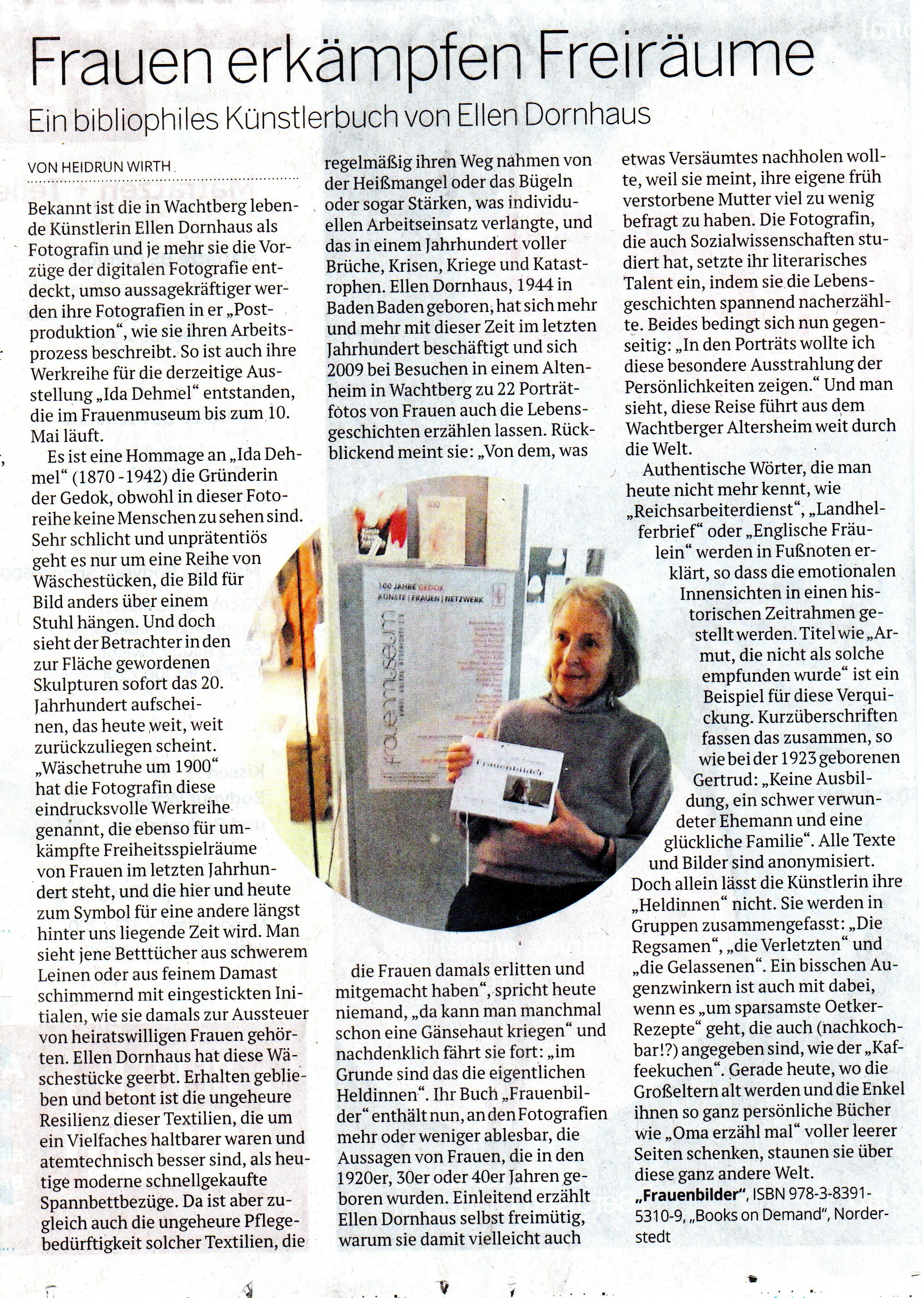

Generalanzeiger Bonn 24.02.2023
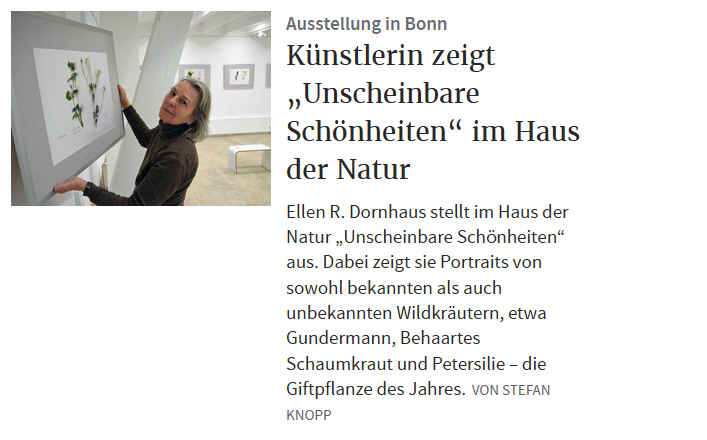
Generalanzeiger Bonn 25.01.2023
General-Anzeiger 14.2.2022
Generalanzeiger Bonn 14.02.2022
Dr. Heidrun Wirth:
6./7. 07. 2019 Ausstellung
"Ellen R. Dornhaus war mit hochinteressanten Fotoarbeiten dabei, der Schwerpunkt lag dabei auf Waldbildern vom Kottenforst..."
4.4.2018 Bonner Rundschau zur Ausstellung
12.10. 2017 Bonner Generalanzeiger zur Ausstellung
5.08.2017 Wir Wachtberger zur Ausstellung
23.05. 2016 Bonner Generalanzeiger zur Ausstellung
1.07.2015 Werbekurier zur Ausstellung Fotoarbeiten gemeinsam mit Hon Sang Tong - Skulpturen,
29.08.2015 Bonner Generalanzeiger zur Ausstellung
2014
25.09.2013 Bonner Generalanzeiger zur Ausstellung
Bonner Rundschau 28. Februar 2026
Dr. Heidrun Wirth: "Frauen erkämpfen Freiräume"
Generalanzeiger 20.Januar 2026
aus dem Artikel "Hommage an Ida Dehmel" von Gudrun von Schoenebeck
Der Autorin dieser Zeilen gefallen die leisen Töne, die Dehmel als kraftvolle, aber auch verletzliche Person begreifen, am besten. Dazu gehört... die sechsteilige Fotoserie "Aus der Wäschetruhe" von Ellen R. Dornhaus mit gestärkten Tüchern, die über Stuhllehnen hängen.
Bewertung aus "Lensculture":
Portfolio FeedbackHi Ellen-
I have to admit that I was excited to write about your images. While on the surface they appear quite simple, there are volumes to be discussed about the implications of what you are sharing. As I mentioned, there is something wonderfully disarming about your photographs. Given the spare circumstances of each scene, the images elicit a certain simplicity: after all, they are cloth draped over furniture, with very little else to consider as part of the narrative. Yet it is exactly that simplicity that invites the viewer to dive deeper into the ideas of what you are presenting. And if the images were not crafted as well as you have done, perhaps they wouldn't demand further digestion. But the lighting, the staging, and the other technical aspects of your work indicate that these are scenes worth spending time with. Once I am there, I spend time with each piece of linen. I am reminded that, like cutlery, the designs on the linen probably have very specific origins and meaning: much like the familial lineage that can be found in a coat of arms or the stamp in a wax seal, my guess is that the patterns and weave in each piece bears particular significance to an artisan or factory that was producing that type of work. Of course, dialing into such details also prompts the contemporary viewer to engage in a comparison: are there similar nuances available today? Can we tell the difference between something purchased at Target or at Ikea? And if so, are the differences fewer than before? Also, what does it feel like to know something was made, by hand, in a small shop versus in a massive factory? There are countless narratives one could formulate in their head. So, there is nothing I would recommend to change about the photographs other than perhaps including more, and submitting them as a series. As single images, I don't feel these images will be understood. But as a series, the aggregate forms an idea/narrative that bears exploring further. I do recommend revisiting the statement. I look at photographs every day, 365 days a year. And I feel like I have a relatively trained way of knowing how to interrogate and dive into images. But many people don't do this for a living. And therefore, they may not make the associations and connections that I described above. So, even if you don't agree with what I suggested, perhaps you can find your own set of observations and/or questions to write about and spur your audience. The statement is an opportunity to help draw your audience into spaces they may not immediately explore. All the while, I would be cautious about telling your viewer exactly what to see. You want to offer a space for them to do their own thinking...
There's so much to say about this project, Ellen. And again, that's one of the great strengths of what you have done: by taking something apparently simple, you have opened up a world of possibility.
Thank you for sharing these images and wishing you all the best of luck.
p.s. since you are continuing this project, I would be conscious of creating an even, and diverse (or not) mixture of objects on which you pose the linens--i.e. different chairs, tables, beds, etc.
https://ga.de/news/kultur-und-medien/regional/ausstellung-in-bonn-ida-dehmel-im-frauenmuseum_aid-142067509
Bonner Rundschau 10. Juli 2025
Dr. Heidrun Wirth: Einführung in die Ausstellung "blühen und verblühen" im Kunstraum Bad Honnef
Dr. Heidrun Wirth: Einführung in die Ausstellung "Fake oder Fakt" in der Galerie Meerkatze
Bonner Rundschau vom 11. September 2024
Rheinzeitung vom 16. September 2024
Im ehemaligen SeaLife in Königswinter zeigen Künstlerinnen der GEDOK Bilder unter dem Titel "Nah am Wasser""
Heidrun Wirth schreibt zu den Bildern von Ellen R. Dornhaus: ...Sie würdigt das Wasser in einem schlichten, aber umso eindringlicheren Stilleben mit dem Titel "Wasser und Brot" ....
In ihrer Einführung zur Vernissage schreibt sie: Ellen Dornhaus nobilitiert das Wasser ganz auf ihre Art, sie bindet es in ihren fotografischen Arbeiten in ein Stillleben ein oder lässt es sprudelnd über eine scharfe Messerklinge laufen, auch hier wieder Ruhe und Bewegung.
Kölner Stadt-Anzeiger Euskirchener Land vom 27. März 2024 Seite 22
Im sanierten Kunstforum Eifel ist eine Gemeinschaftsausstellung mit Werken von 52 Teilnehmern zu sehen - Gewalt, Krieg und Angst.
"Bei den Künstlern überwiegen düstere Visionen"
...Ellen R. Dornhaus aus Wachtberg stellt ihre acht Collagen aus Kinderzeichnungen und Digitalfotografien unter den gemeinsamen Titel -Das Gegenteil von Spiel ist nicht Ernst, sondern Wirklichkeit-. Auch hier geht es um Krieg, Bedrohung, den Einbruch von Gewalt und Zerstörung in den Alltag. ....von
Stefan Lieser
Pressemitteilung der Bezirksvertretung Bad Godesberg vom 24.10.2023
"Gartenelegien"
Ellen R. Dornhaus und Anja Eichen zeigen ihre Werke im Haus an der Redoute.Gartenelegie
Was war, was ist, was wird sein,
das ist der Titel der neuen Ausstellung, die ab 10. November 2023 im Haus an der Redoute, zu sehen ist.
Gezeigt werden zahlreiche Werke der beiden Künstlerinnen aus Bad Godesberg. Durch das Zusammenspiel der beiden Künstlerinnen wird das Thema Garten aus unterschiedlichen Perspektiven beleuchtet. Gemeinsam soll es uns gelingen das Thema sprachlich und inhaltlich zu erweitern und zu vertiefen. Durch die künstlerische Kombination von Fotografie und bildgewordener Sprache fließt das gedankliche Umfeld zum Thema Garten in das Konzept mit ein und macht die Präsentation noch anschaulicher.
Die Kunstwerke von Dornhaus und Eichen können noch bis zum 3. Dezember 2023, jeweils mittwochs bis sonntags von 14 bis 18 Uhr, im Haus an der Redoute, Kurfürstenallee 1a, Bad Godesberg, besichtigt werden. Der Eintritt ist frei. Die Vernissage findet am Donnerstag, den 9. November 2023 um 18 Uhr im Haus an der Redoute statt. Nach der Begrüßung durch die stellvertretende Bezirksbürgermeisterin von Bad Godesberg, Elke Melzer, führen die Künstlerinnen selbst in die Ausstellung ein.
Bonner Rundschau vom 11.03.2023
"Schwarz-Weiss, Aschermittwoch der Künstler"
... Ganz anders geht die ebenfalls in Wachtberg lebende Fotografin Ellen Dornhaus vor, die in der Region schon an zahlreichen Ausstellungen teilgenommen hat. In ihren Naturfotografien entdeckt sie "den Wald vor meiner Tür" oder die "unscheinbaren Schönheiten in Wald und Natur", wie in einer Ausstellung im Haus der Natur (an der Waldau) noch bis zum 19. März zu sehen. Doch hier zeigt sie in ihrer Reihe "gepflückte Pflanzen" zwei Tulpen, die sich aus einer unsichtbaren Vase herauszuwinden und zu befreien scheinen. In diesem "Stillleben" unserer Tage scheinen die Pflanzen durchaus nicht mehr dem menschlichen Willen unterworfen zu sein....von
Dr. Heidrun Wirth
Generalanzeiger Bonn 24.02.2023
Generalanzeiger Bonn 25.01.2023
Kölner Stadtanzeiger 12.Juli 2023 S. 24
Von Melancholie umflort
Fünf Kunstschaffende legen Werke zum Thema ,,Heimat" vor
VON HANNA STYRIE
...Von Melancholie umflort sind die Fotoarbeiten von Ellen Ruth Dornhaus. Sie hat Blumensträuße in alten Vasen aus Familienbesitz arrangiert und kurz vor dem Verwelken fotografiert. Sie dienen der Künstlerin als Symbol für Vergänglichkeit; mit dem Liedtext ,,Sag' mir wo die Blumen sind", den sie in der Mitte der Aufnahmen platziert hat, spielt sie auf den Krieg gegen die Ukraine an. Persönliche Erinnerungen und Heimatgefühle verknüpft sie mit dem stattlichen ,,Elisenhof", den sie in fast malerischer Weise abgebildet hat....
Ausstellung in der Städtischen Galerie Wesseling im Schwingeler Weg
Dr. Josef Gülpers zu den Arbeiten von Ellen Dornhaus in der Ausstellung "Heimat"
Im Alter von vierzehn Jahren absolvierte Ellen Ruth Dornhaus ein Jahr als Austauschschülerin in den USA, sie studierte Malerei in Hamburg und an der Kunstakademie in Düsseldorf zur Zeit Joseph Beuys' und arbeitete als Lehrerin für Kunst und Sozialwissenschaften. Aus der Malerei habe sie einen Blick für Komposition, Farbstimmung, Spannung im Bild, Schärfentiefe und die Arbeit mit Kontrasten mit in die Fotografie genommen. In erster Linie ist sie Fotografin, aber häufig kombiniert sie ihre Fotografien mit Zeichnungen. Dabei können verrätselte, märchenhafte, verwunschene Welten entstehen. Die Schulferien verbrachte Ellen Ruth Dornhaus stets bei ihren Großeltern im Westerwald und sie schwärmt heute noch von der großen Freiheit, die sie beim Spielen im Wald empfand. Viele ihrer Bilder verweisen auf diese Kindheitserinnerungen und die Künstlerin vermischt diese Momente der Erinnerungen mit Märchenmotiven. Zum Thema Heimat äußerst sich die Künstlerin wie folgt: "Eine gültige Begriffsdefinition für HEIMAT konnte ich nicht finden. Ist es ein Ort oder eher ein Gefühl? Als ich Kind war, ist unsere Familie mindestens viermal umgezogen, als Erwachsener habe ich noch häufiger nicht nur Wohnung, sondern auch die Stadt/den Ort gewechselt. Was wäre dann für mich HEIMAT? "Heimat" ist jedenfalls nicht etwas, was ich mir für die Zukunft vorstelle, sondern eher etwas Vergangenes, eine Sehnsucht und Erinnerung. Meine Arbeiten zum Thema sind daher eher nicht Abbild von "Wirklichkeit", sondern zeigen z.B. eine schöne Welt (Blumen, Traum), aber auch Albtraum, manchmal düster und ein bisschen geheimnisvoll (diese Wirkung wünsche ich mir jedenfalls)." Die Objekte auf ihren Fotografien sind aus ihrer alltäglichen Umgebung isoliert, die Künstlerin gibt ihnen eine neue Bedeutung, stellt sie in einen neuen Funktionszusammenhang. "Das Objekt kann eine Ausstrahlung besitzen, eine Seele haben, auf etwas verweisen, was nicht sichtbar und intellektuell nicht erklärbar ist. Es ist nicht Information, sondern Erlebnis, das transportiert wird", erklärt die Künstlerin. Die Planung eines Stilllebens sei für sie ein Bewusstwerden ihres Selbst, ein Selbstfindungsprozess." Das Ergebnis, das Bild, ist trotzdem nicht rein persönlich zu verstehen, sondern zeichnet die Spur des Lebens einer Frau, die um die Jahrtausendwende lebt", so die Fotografin. Ellen Ruth Dornhaus lebt am Rande eines Waldes und dieser Wald prägt ihre Kunst, und als Künstlerin schaut sie ganz genau hin und nimmt jede Veränderung des Lichts wahr. Die Fotografie ist für sie zunächst Ausgangsmaterial, mit dem sie weiter arbeitet. Sie liebt den regennassen Wald, wenn die Tropfen von den Blättern rinnen ebenso wie den feinen Morgendunst. Diese Stimmung überträgt sie auf ihre Fotografien, sodass man oft nicht weiß, ob dies eine Fotografie oder eine feinstrichige Zeichnung ist. Licht und Farbe sind für sie wichtig. Farben bewegen uns, berühren uns, rufen Stimmungen in uns wach. Manchmal ändert die Künstlerin die Farbe und macht zum Beispiel aus einem Blaugrün ein Gelbgrün, um eine besondere Stimmung hervorzurufen. Man könnte sagen, Ellen Ruth Dornhaus malt mit der Kamera und oft dauert es eine Woche, bis sie mit der fotografischen Bearbeitung zufrieden ist. Die Künstlerin nennt auch ihre Werke nicht Fotografien, sondern Fotoarbeiten. Sie verstärkt den Kontrast, ändert die Farbe, doppelt Motive oder kombiniert zwei Bilder. "Ich bin nicht an die Realität gebunden", sagt sie. Gewöhnlichen Alltagsgegenständen verleiht Ellen Ruth Dornhaus eine besondere visuelle Kraft, Sinnlichkeit und Bedeutung. Diese Geduld, dieser Perfektionismus führt zu einer vollkommenen ästhetischen Komposition, die sich auf das Wesentliche konzentriert.
Rhein-Zeitung vom 12.05.2022
Das M.A.SH. in der Kirchstraße/Ecke Drususplatz bittet am 15.Mai 2022 um 16 Uhr zur Vernissage. Zu sehen gibt es die Ausstellung
"Die Sprache der Dinge" von Ellen R. Dornhaus
Auf ungewöhnlich Weise inszeniert die Wachtberger Fotografin auf ihren Fotos Objekte: Indem sie diese aus ihrer alltäglichen Umgebung isoliert, gibt sie den Gegenständen eine neue, von ihrer eigentlichen Funktion unabhängige Bedeutung. " Das Objekt kann eine Ausstrahlung besitzen, eine Seele haben, auf etwas verweisen, was nicht sichtbar und intellektuell nicht erklärbar ist. Es ist nicht Information, sondern Erlebnis, das transportiert wird" , erklärt Dornhaus. Die Planung eines Stilllebens sei für sie ein Bewusstwerden ihres Selbst, ein Selbstfindungsprozess. " Das Ergebnis, das Bild, ist trotzdem nicht rein persönlich zu verstehen, sondern zeichnet die Spur des Lebens einer Frau, die um die Jahrtausendwende lebt" , so die Fotografin.
"Landwirtschaft und Ernährung"
VHS Bonn Zweigstelle Bad Godesberg vom 9.2. bis 7.4.2022General-Anzeiger 14.2.2022
1.12.2021 Bonner Rundschau, bonner.rundschau@kr-redaktion.de
Spannende Motive und Inspiration findet die Künstlerin Ellen Dornhaus im Kottenforst.Dr. Heidrun Wirth: "Glitzernde Tropfen im Morgendunst"
Foto: Martin Magunia
Ellen Dornhaus wohnt in der Waldstrasse in Villiprott unmittelbar am Rande des Kottenforstes, und diesen angrenzenden Naturschatz hat sie für ihre Kunst entdeckt. Sie sieht ihn mit den Augen einer Künstlerin, die sich für die Fotografie entschieden hat. Was ihr der Wald aber künstlerisch und emotional bedeutet, erklärt sie direkt am Ort: "Ein ganz kleines Sonnenstrählchen. Unglaublich, wie sich die Konturen im Licht verändern," sagt sie und weist auf die regennassen Blätter hin, auf glitzernde Tropfen und den feinen Morgendunst, der über den Waldweg in der Ferne auf- oder abzieht. Und dies versucht sie auch in ihre Fotografien zu übertragen, in denen sie die Linien der Äste und die Konturen der Rinde so betont, dass man meint, eine feinstrichige Zeichnung vor sich zu haben. Solche zarten und doch geheimnisvollen Zeichnungen stehen in langer kunstgeschichtlicher Tradition und finden sich bereits bei den Spätromantikern wie Alfred Kubin. Es ist also auch eine Fortsetzung mit anderen Mitteln, die sich hier Bahn bricht. Anders wirkt eine Farbaufnahme, auf der man tief in den Wald mit seiner warmen Herbstfärbung blicken kann und dabei dem Spiel des schräg einfallenden Lichtes zuschaut. Und die Künstlerin erklärt: "Ich glaube, die Farbe bewegt uns mehr emotional, auch die kann ich beeinflussen, aus einem Blaugrün mache ich manchmal ein Gelb-grün." Dabei geht es ihr nicht wie den Expressionisten ums Verfremden der Farben, sondern nur um ein sanftes Vertiefen, ein malerisches Hervorlocken, das durch Farb- und Lichttemperatur unterstrichen wird. "Ich bin eigentlich Malerin, mit der Kamera bediene ich mich eben nur des Materials der Daten statt Farben und Pinsel. Doch mein Ziel ist dasselbe, nämlich ein Bild überzeugend werden zu lassen, ob ich die Schärfe einstelle und den Reliefcharakter betone oder ob ich lieber weiche, diffuse Uebergänge schaffe, wenn etwas "Märchenhaftes oder vielleicht auch Unheimliches dabei herauskommen soll." Und sie deutet auf das tiefe Schwarz in einer kleinen Fichtenschonung. Und doch ist diese besondere Beziehung zum Wald schon viel früher grundgelegt, berichtet die 1944 geborene Künstlerin. Sie erzählt vom Leben auf dem Lande bei ihren Großeltern, dem Großvater, der Forstwirtschaft studiert hatte, und vor allem von der grossen Freiheit, die sie beim Spielen im Wald immer empfand. Frische, klare Luft zieht durch den Wald, und Ellen Dornhaus meint: "Ich finde es schön, daß man nun coronabedingt den Wald wiederentdeckt. Man muß dabei ja gar nicht weit fahren, im Wald kann man immer etwas entdecken, etwas riechen und fühlen. Mein Ziel ist auch, im Einfachen das Schöne zu sehen, und auf den Reichtum ständiger Veränderungen aufmerksam zu machen, die alle Sinne ansprechen." Aufgefallen ist ihr, dass man den Pflanzen bisher viel zu wenig Augenmerk geschenkt hat, während die Tiere im Wald in vielen Fotobänden festgehalten wurden. "Jede Pflanze ist eine eigene Art, und dass Pflanzen sich nicht vom Ort wegbewegen können, stimmt auch nicht, schaut man nur einmal das Brombeergestrüpp am Wege an, das immer neue Flächen besiedelt". In ihren digitalen "Zeichnungen" von Kräutern und Schösslingen versucht sie dem Aussehen der Pflanze so nahe wie möglich zu kommen "ohne dabei die "Seele" des Gewächses zu vergessen." Ellen Dornhaus, die dem Godesberger Fotoclub angehört und durch Ausstellungen in der Region bekannt wurde, hatte sich auf eine Ausstellung in der Bezirksbibliothek Bad Godesberg vorbereitet, die nun coronabedingt auf den März verschoben ist."
27.02.2020 Im General-Anzeiger Bonn schreibt Silke Elbers:
Bei der40. Schwarz-Weiss-Ausstellung
im Haus an der Redoute zeigen 45 Künstler ihre Werke. ... Ein im positiven Sinne alter Hase ist Ellen R. Dornhaus im Haus an der Redoute. Diesmal hat sie sich für zwei Fotografien entschieden, die beide der naturalistischen Darstellung in der Malerei nachempfunden sind. Eine Spüle, in der Wasser über eine Messerklinge rinnt, zeigt das eine Stillleben. "Scheinbar eine Alltagsszene, aber dahinter steckt zum einen das Thema Gewalt, zum anderen auch der Umgang mit Wasser als kostbarem Gut und Stahl als menschengemachtem Produkt", führte die Wachtbergerin aus. ..."
6./7. 07. 2019 Ausstellung 13. Kulturwochen Wachtberg
im Kulturgarten Rosenberg, Gemeinde Wachtberg:
"Ellen R. Dornhaus war mit hochinteressanten Fotoarbeiten dabei, der Schwerpunkt lag dabei auf Waldbildern vom Kottenforst..."
6.04.2019 Bonner Rundschau zur Ausstellung "Waldes Dunkel"
Dr. Heidrun Wirth:
" Vollendete Kompositionen"
Geht man gegenwärtig durch des "Waldes Dunkel" in der so betitelten Ausstellung im Haus an der Redoute, ist man zunächst nur bezaubert von den Waldfotografien von Ellen Dornhaus. Unversehens merkt man aber bald, dass hier wieder einmal ein neues Zwischenglied in der Kunst entdeckt wurde. Wie das "missing link" als mögliches aber noch nicht entdecktes Übergangsglied in der Evolutionsgeschichte, so hat Ellen Dornhaus eine neue, bislang noch fehlende grafische Zwischenform geschaffen, die am Übergang von der Radierung und anderen grafischen Handdruckverfahren zur Fotografie steht. Es dauert oft eine ganze Woche bis die Künstlerin, die eigentlich von der Malerei kommt, mit der fotografischen Bearbeitung zufrieden ist, dass sie ein Blatt ausdrucken möchte. Doch was dann herauskommt ist ästhetisch vollendet komponiert und auf das Wesentliche konzentriert. Hell wird die Rückenfigur am Waldrand vom Licht umspielt, doch der Blick in den Wald verliert sich schnell im dunkel, bis er wieder auf den korrespondierenden Lichtstrahl in der Tiefe des Waldes fällt. Und man muss lange darauf schauen um festzustellen, dass dies hier keine Grafik in Form einer Vermis-mou-Ätzung (Flächenätzung), sondern reine Fotografie ist. "Waldes Dunkel" ist der Titel dieser geheimnisvollen Bilder, die zumeist im Kottenforst fotografiert wurden an dessen Rand die Künstlerin wohnt. Die Wald-Bilder sind mit Fotografien von romanischen Steinmetzarbeiten aus Maria Laach und den geheimnisvollen Torbogenfragmenten aus der uralten Kirche in Remagen bereichert. All das passt zum Wald, seinen Geistern und Märchenfiguren in der Spannung zwischen vertrauter Schönheit und tiefer Unergründlichkeit. Die Betonung der Konturen und die Farbsättigung führen zu vollendeten Kompositionen. Der Fotograf August Sander hat in der ersten Hälfte des 20. Jahrhunderts auf analogem Wege Ähnliches angestrebt. Das Besondere ist allerdings auch, dass die Kunst von Ellen Dornhaus nicht in der Technik stecken bleibt, sondern das jenes "Waldes Dunkel" zu einer Ode auf die Natur wird."
30./31.03.2019 Bonner Generalanzeiger zur Ausstellung mit dem Titel "Waldes Dunkel" von Ellen R. Dornhaus
Stefan Knopp:
"Zwischen Bäumen verschwindet die Realität"
Die Fotoarbeiten zeigen den Wald - vor allem den Kottenforst und andere in der Umgebung - in den unterschiedlichsten Facetten, mal verwunschen im Gegenlicht, mal als Symbol der Stärke oder für Vergänglichkeit und mal mit einem digital eingeführten Wolf als Bezug zum Rotkäppchen-Märchen. Dornhaus bezeichnet bewusst ihr Werke nicht als Fotografien, sondern als Fotoarbeiten, weil sie ihre Aufnahmen digital verändert hat: nachträglich verstärkter Kontrast, Doppelungen der Motive oder auch Kombination zweier Bilder. "Ich bin nicht an die Realität gebunden." Manche Fotografen würden über ihre Arbeiten sagen, dass sei ja gar keine Fotografie mehr, sagt sie. "Fotos sind heute ein Haufen Pixel, die kann man bearbeiten. Und das bedeutet, dass sich die Fotografie der Malerei immer weiter annähert." Dornhaus weiss, wovon sie spricht. Seit 15 Jahren fotografiert sie, davor hat sie gemalt, vor allem märchenhafte Motive. Studiert hat sie das Ganze an der Kunstakademie Düsseldorf zur Zeit von Joseph Beuys. Aus der Malerei habe sie einen Blick für Komposition, Farbstimmung, Spannung im Bild, Schärfentiefe und die Arbeit mit Kontrasten mit in die Fotografie genommen."
4.4.2018 Bonner Rundschau zur Ausstellung "Tuchfühlung"
von E. R. Dornhaus
Dr. Heidrun Wirth schreibt :
"..Man sieht z.B. einen Tisch mit einem säuberlich gebügeltem weissen laken-ähnlichen Decke, darauf im schrägen Lichteinfall eine stehende und eine umgestürzte Tasse mit leerem dunklen Rand, daneben ein weiss verhüllter Stuhl. "Zwei Tassen und Braut" lautet der lapidare Titel, doch man könnte einen ganzen Roman dazu schreiben."
12.10. 2017 Bonner Generalanzeiger zur Ausstellung "Sieben"
der Gruppe Sieben
Sofia Grillo schreibt:
" E.R.D. beschäftigt sich in ihren ausgestellten Werken mit den sieben Grundemotionen, zwischen denen in der modernen Psychologie unterschieden wird. Dafür zeigt sie auf den Fotoarbeiten Puppengesichter mit unterschiedlichster Mimik. Die Werke wirken in schummrigem Licht wie aus einem Horrorfilm entnommen"
5.08.2017 Wir Wachtberger zur Ausstellung "Geschichten und Träume in Bildern und Fotos"
von Ellen R. Dornhaus
Margit Mertens schreibt :
"..Kinderwünsche ins Bild gesetzt: Und so zeigt die kleine Ausstellung neben den bunten Bildern der aus Albanien, Syrien und Tadschikistan kommenden Kinder parallel dazu von Dornhaus gemachte Fotos, auf denen sie festgehalten hat, wie die Kinder in Gruppen gearbeitet haben.."
23.05. 2016 Bonner Generalanzeiger zur Ausstellung "Sommer unseres Vergnügens"
im Künstlerforum Remagen
Hildegard Ginzler schreibt:
"Die Puppen in den Fenstern des Küfo-Domizils, die E.R.D. aus Wachtberg mit Fliess- und Rheingold-Assoziationen lokal leicht anverwandelt hat, locken in Abgründe. Mal dreiäugig im Wasser treibend, mal mit umflorten Teenageraugen und gepressten Lippen oder hinter böser goldener Vogelmaske, lehren sie einen das Gruseln. Dennoch passen sie in den Kultursommer."21.05.2016 Blick aktuell zur Ausstellung "Sommer unseres Vergnügens" im Künstlerforum Remagen
"Mit digitalen Bildtechniken simuliert E.R.D. den Eindruck authentischer Fotografie. Gewöhnlichen Alltagsgegenständen verleiht sie eine besondere visuelle Kraft, Sinnlichkeit und Bedeutung.."25.05.2016 Rheinzeitung
"Mysteriös, fast verstörend wirken die Arbeiten von E.R.D., die in drei Fenstern der Villa Heros zu sehen sind. Das Dokumentarische der Fotografie spielt bei diesen Bildern überhaupt keine Rolle mehr. Vielmehr erzeugt die Fotokünstlerin, die einmal Malerei studiert hat, durch geschickte Überblendungen einen gemäldehaften Effekt. Fotografiert hat sie stets ein und dieselbe Puppe, doch der Ausdruck verändert sich ..nachhaltig.."25.05.2016 Remagener Nachrichten
" ..Die Künstlerin stellt hierbei eine Puppe in den Fokus ihrer Werke, deren Ausstrahlung dreimal stark variiert. Überblendungen und der Fokus auf verschiedene Stofflichkeiten wie Wasser, Seide, Stein oder Holz machen die Effekte möglich.."
"Schattenlichter"
(Soloausstellung), "Pauke" Bonn.Frau Glufke, Presse- und Öffentlichkeitsarbeit, schrieb mir (13.07.2016):
".. Ihre Ausstellung sorgt für ausserordentliche Resonanz in unserem Kulturbistro. So sehr Ihr professionelles Schaffen als Fotografin gelobt wird, so verstören die Exponate mit den Puppen-Motiven viele unserer Gäste und unsere Mitarbeiter (Angstzustände und Panikattacken).."
Herbstausstellung Kunstforum Waischenfeld
Dieter Jenss schreibt (Pressemeldung Waischenfeld Sept. 2016)
"..Im Vordergrund ihrer künstlerischen Arbeit steht die Idee, welche sie vor ihrem geistigen Auge hat. Dabei ist der Bildfindungsprozess die eigentliche Aufgabe ihrer Arbeit, mehr noch als die Aufnahme selbst. Ihre Motive findet die Künstlerin in ihrer alltäglichen Umgebung. Sie setzt die jeweiligen Lichtverhältnisse als Stimmungsträger gezielt in ihren Bildern ein. Ihre düster wirkenden Stillleben sind geprägt von der Wirkung im Detail.."
1.07.2015 Werbekurier zur Ausstellung Fotoarbeiten gemeinsam mit Hon Sang Tong - Skulpturen,
"Kunstverein Wesseling ArtForum"
Detlev Junker schreibt:
"..Durch die Fotografie erhalten diese gewöhnlichen Alltagsgegenstände, die normalerweise nicht beachtet
werden, eine visuelle Kraft, eine eigene Sinnlichkeit und Bedeutung.."
29.08.2015 Bonner Generalanzeiger zur Ausstellung "Die Klais Orgel"
(Soloausstellung) Rathaus Siegburg
Paul Kieras schreibt im Generalanzeiger Bonn-Rhein-Sieg
" ..Das ist auch auf den Bildern zu erkennen, die ausnahmslos nicht gestellt sind, sondern die hohe Konzentration der jeweiligen Handwerker und tiefe Versunkenheit in ihre Arbeit überzeugend vermitteln. Die Aufnahmen sind durchweg von hohem künstlerischen und ästhetischen Reiz.."
2014 "Alice in Underworld"
Haus an der Redoute, Bonn;
Einführung von Prof. H. Schäfer:
"..Ich habe schon viele Ausstellungen eröffnet, eine solche noch nicht.. Zunächst müssen wir uns freimachen von der Erwartung, dass nämlich Fotos die Wirklichkeit abbilden.. E.D. stellt die Wirklichkeit in einen anderen, jedenfalls meist unerwarteten oder überraschenden Zusammenhang. Hier ist E.D. bei weitem nicht mehr in erster Linie Fotografin. Sie wird zur Künstlerin.. Diese Ausstellung bestätigt die These, dass Frauen unterschiedlich fotografisch arbeiten. Dies ist eine Ausstellung, wie sie ein Mann wahrscheinlich nicht realisieren würde. Warum? - weil sie in ihrer Technik eine Mischung zwischen Weichzeichnung, Kontrasten sowie Bildhärten wählt, die ich für feminin halte: -weil sie eine feminine Diskretion pflegt und ins Bild setzt;.. -weil sie die Motive feminin sieht und mit weiblicher Psyche analysiert.. Eine Ausstellung dieser Art will nicht allein intellektuell erfasst sein, sie will vor allem erfühlt werden.."
25.09.2013 Bonner Generalanzeiger zur Ausstellung "Orgelklang aus Bonn"
von Ellen R. Dornhaus im Stadtmuseum Bonn
Claudia Wallendorf schreibt:
"..Zum anderen hat Dornhaus einen Blick für Details und Muster. Vermeintlich profane Werkzeuge wie etwa Formhölzer oder Pfeifenfüße wirken - nun losgelöst von ihrer Funktion- wie arrangierte Bildkompositionen.."